The Phoenix Must Die Before It Can Rise Again! Initiation Rites and Transitional Rituals for Men in a Disoriented Age
We live in a time in which men may reach biological adulthood, yet often remain inwardly suspended between youth and maturity. They take on responsibilities, pursue careers, and start families, yet frequently lack inner clarity, depth, and direction. Many appear functional, but not transformed. The reason for this is not a lack of ability, but a fundamental loss: our society has largely lost conscious transitions. The life of a man is not a continuous process of aging, but a sequence of thresholds that must be crossed. These thresholds do not only mark external changes; they demand inner transformation.
And every true transformation follows the same principle:
Something old must die so that something new can come into being.
The Initiations of a Man
Life repeatedly confronts a man with transitions that force him to let go of his previous identity and grow into a new form. These transitions are not optional stages of development, but necessary processes on the path to maturity.
In traditional cultures, these thresholds were accompanied by rituals. These rituals provided structure, orientation, and above all meaning. They were never merely psychological; they were always religious. A man was not only introduced into a new role, but into a deeper relationship with himself, with the community, and with God.
All of these transitions follow the same inner structure. At their core, they are processes of rebirth.
Coming of Age – The Separation from Childhood
The first major transition in a man’s life is the separation from childhood. This step is far more than reaching a certain age. It requires a conscious inner separation from dependency, especially from parents and from the mother as the emotional center.
A boy lives in protection and provision. A man, however, is called to carry his own life. This shift is not merely external, but deeply internal. It means taking responsibility—even for uncertainty, mistakes, and consequences.
Without this separation, a man remains inwardly bound. He continues to seek security outside himself, avoids decisions, and remains emotionally dependent.
Here, the importance of religion already becomes visible. Faith is no longer simply inherited; it becomes a personal decision. The young man enters into a personal relationship with God and begins to orient his life consciously. Religion provides a framework that extends beyond the family.
Marriage – Entering a Greater Order
Marriage represents another fundamental transition. It is not merely the union of two individuals, but a step into a binding order that transcends the self.
A man who marries consciously commits to fidelity, reliability, and responsibility. This decision means relinquishing part of his independence and binding himself to something greater. Without inner maturity, marriage is experienced as a limitation. With maturity, it becomes a path of inner development.
From a religious perspective, marriage is a covenant that binds a man not only to his partner, but also to God. It gives the relationship a depth that goes beyond individual needs. Marriage becomes a space in which a man learns to transcend himself and assume responsibility.
Fatherhood – Responsibility for Life
With the birth of a child, a man’s perspective fundamentally changes. He no longer stands only for himself, but for a new life that depends on him.
A father is called to provide protection, orientation, and stability. This role requires inner firmness and authenticity. A child immediately senses whether a man is inwardly grounded. At this stage, the center of life shifts. It is no longer primarily about one’s own needs, but about the life entrusted to him.
From a religious perspective, fatherhood gains a deeper dimension. The father becomes a bearer of values and a source of orientation. At the same time, he is confronted with the question of how he lives his life before God.
Midlife – Confrontation with Truth
Midlife is often experienced as a crisis, but in reality, it is a phase of truth. In earlier years, a man can compensate through achievement, success, and external structures. But eventually, these strategies lose their power.
Questions arise that can no longer be suppressed:
What truly sustains me? Was my life authentic? What was illusion?
This phase strips away the possibility of defining oneself through external things. It forces a man to confront himself.
Here, the religious dimension becomes central again. The question of meaning emerges with full force. It is no longer about external success, but about the significance of one’s life.
Divorce – Collapse and Unwilled Initiation
Divorce is one of the most painful transitions in a man’s life. It does not only mean the end of a relationship, but often the collapse of an entire life structure. Feelings of loss, guilt, anger, and emptiness come to the surface.
And here, a decisive truth of our time becomes visible:
What was once consciously shaped through cultural initiation rituals now often happens unconsciously—and as fate.
In traditional cultures, men were guided through transitions. Initiation was voluntary, supported, and embedded in community and religion. Today, these conscious rites of passage are largely absent.
Yet the necessity for transformation remains. What once happened through ritual now happens through crisis.
In this sense, divorce becomes for many men an unwilled initiation. What is consciously enacted in ritual—letting go, rupture, reorientation—now unfolds through pain, chaos, and loss of control.
The difference is decisive:
In the past, culture guided the transition.
Today, life forces the transition.
The Dark Night of the Soul – The Deepest Transformation
The deepest initiation takes place inwardly. In spiritual tradition, it is called the “dark night of the soul.” In this phase, all external certainties lose their meaning. Roles, identities, and self-images dissolve. A man stands before an existential emptiness in which nothing holds.
This experience is painful, yet essential. It forces one to let go of everything that is not essential.
From a religious perspective, this darkness is not an end, but a transition. The man is not merely changed—he is transformed.
Religion, Fatherlessness, and the Crisis of Masculinity
A central connection of our time is often overlooked: the disappearance of religion has not only spiritual consequences, but profound effects on the development of masculinity.
For centuries, religion provided structure, orientation, and transition. It embodied not only values, but also a form of higher fatherhood.
When this dimension disappears, a vacuum emerges.
And this vacuum becomes visible in the development of many men. Without clear initiation and without a higher orientation, boys often remain emotionally bound to the mother. This bond is necessary, but it must be transcended and complemented for maturity to emerge.
If this does not happen, the inner structure remains childlike, even if the body becomes adult.
The result is not strength, but insecurity.
Not clarity, but dependency.
What is missing is the voice that says:
You must go.
You must take responsibility.
You must carry your own life.
Rebirth – The Pattern of All Life
When all these transitions are viewed together, it becomes clear that they follow the same structure:
They are processes of death and rebirth.
This pattern is deeply religious. At the center of the Christian faith lies exactly this movement:
Death and Resurrection.
That is why the Sunday service is more than a tradition. It is a regular form of this rebirth. A man enters with his burdens, his failures, and his disorder, and is invited to let go, realign himself, and return strengthened.
Individuation – The Search for Meaning
All these processes ultimately lead to one central question:
What is the meaning of my life?
Carl Gustav Jung described this path as individuation. By this, he did not mean superficial self-realization, but an inner process of maturation through which a person becomes what he truly is.
This path does not bypass crises—it goes through them. It includes rupture, loss, and confrontation with one’s shadow.
Individuation is therefore a path of rebirth.
And it shows that a human being cannot live without orientation toward something greater. Without meaning, he remains trapped within himself.
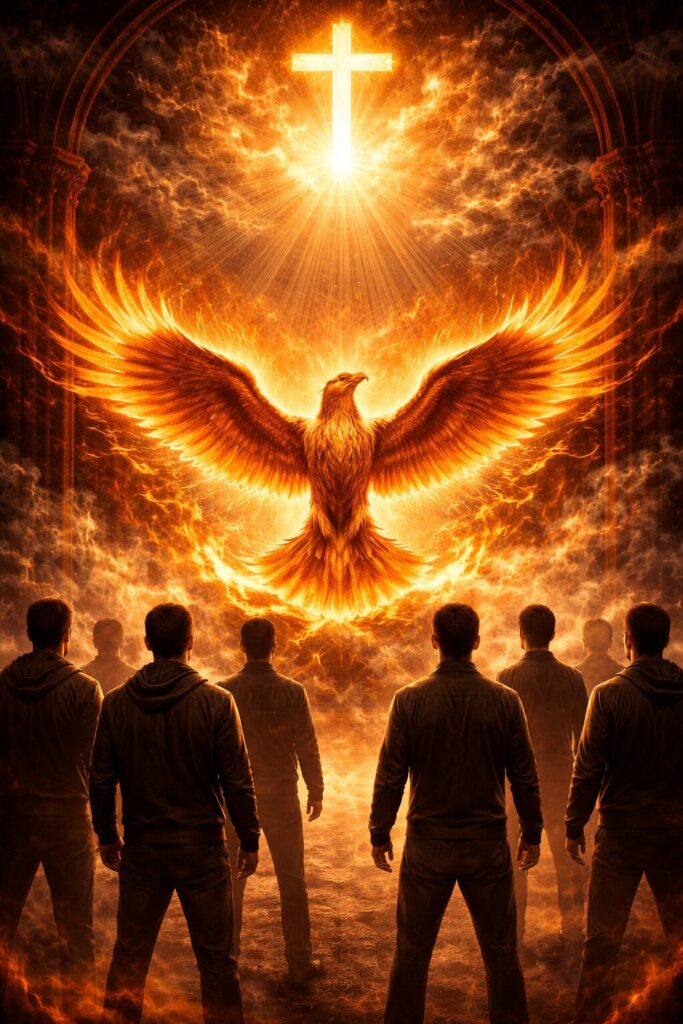
The Phoenix
The image of the phoenix expresses this truth clearly. The phoenix burns completely—not halfway—turns to ashes, and loses everything it was. Only through this can its rebirth become possible.
The life of a man consists of transitions that must be consciously lived in order to achieve true maturity. Without these transitions, development remains superficial and often leads to inner emptiness or later crises.
The modern world has largely lost these rituals. Yet the necessity for transformation remains.
What is not consciously shaped by culture returns as crisis. And so, a simple but uncomfortable truth becomes visible:
A man does not become mature through time, but through transformation.
Jesus Christ – The Living Center of Death and Rebirth
At the center of all these reflections stands not merely a psychological or cultural principle, but a reality that transcends them:
Jesus Christ.
He is not merely a teacher, a moral example, or a historical figure. He is the living center of what unfolds in all initiations, crises, and transitions of human life:
Death and Resurrection.
In his life, the path every human must walk is condensed. The cross represents not only suffering, but the radical break with the old. It represents the end of false securities, the letting go of control, and the death of what no longer sustains.
The resurrection represents the new that cannot be manufactured. It is not the result of human effort, but a gift. It shows that out of collapse, something deeper and more true can emerge.
The deepest truth of all initiation processes is this:
Man cannot recreate himself.
He can only become willing to let go of the old.
The Sunday Service – Participation in Rebirth
In this light, the true meaning of the Sunday service becomes visible. It is not merely remembrance, nor simply tradition or obligation. It is a present participation in this movement of death and resurrection.
A man enters as he is—with his week, his disorder, his failures, his tensions, and his unresolved questions. And precisely there, the process begins.
In acknowledging his limitations, he already lets go. In hearing the word, he reorients himself. In encountering Christ, especially in the Eucharist, he enters into a real relationship with the one who has passed through death and lives. At the end, he is not simply dismissed, but sent out anew.
Thus, the Sunday service becomes a regular form of rebirth—not dramatic, not spectacular, but real.
Final Truth
When all of this is brought together, it becomes clear:
The initiations of life,
the crises of existence,
the search for meaning,
and religious practice
are not separate domains.
They are expressions of one single movement:
From the old to the new.
From holding on to letting go.
From the ego to truth.
And at the center of this movement stands Christ. The phoenix is a symbol. Christ is the truth.
He shows that the way through death is not the end, but the beginning of something new.
The phoenix must die before it can rise again. In Christ, it becomes clear that this resurrection is possible.