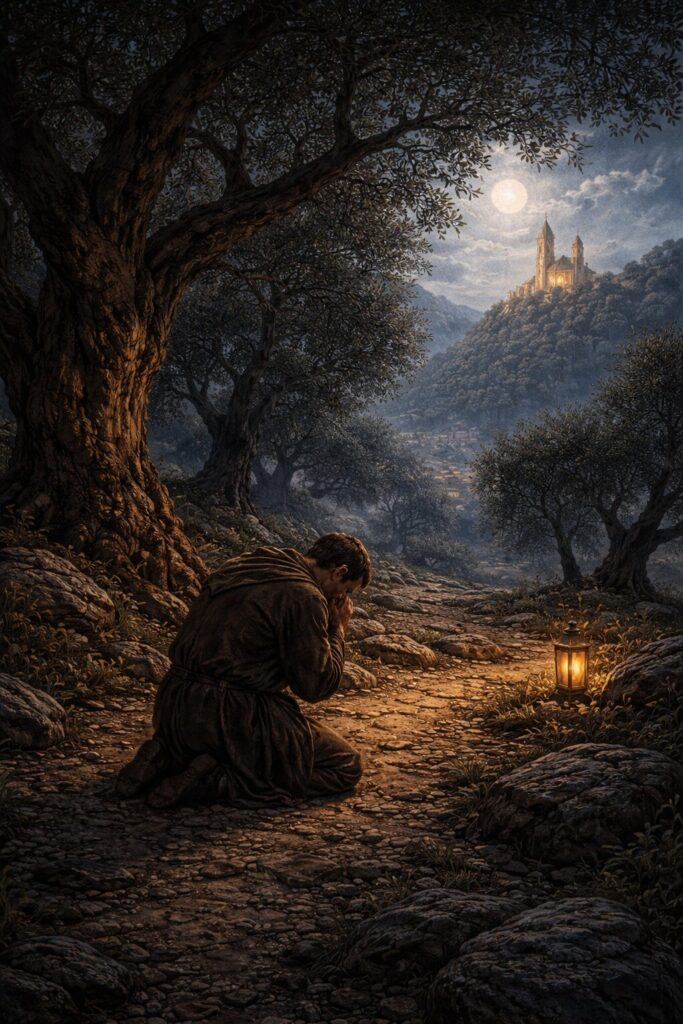
Learning Self-Regulation – Nigredo as the Garden of Gethsemane
Self-regulation is not a technical skill, but an existential path. Anyone who takes it seriously will sooner or later encounter a dark inner threshold—the phase of Nigredo. This phase can be understood not only in alchemical terms, but also spiritually: as one’s personal Garden of Gethsemane.
1. Nigredo and Gethsemane – two images, one process
Nigredo describes the dissolution of old certainties. It is the phase in which the ego no longer holds, familiar structures collapse, and inner darkness emerges.
The Garden of Gethsemane is the biblical counterpart: the place where Christ experiences fear, abandonment, and inner resistance—and yet remains.
Both images point to the same core:
- Confrontation with inner distress
- Loss of control
- The decision between escape or surrender
Self-regulation begins precisely here.
2. The night of self-regulation
In the “Monastery of Nigredo,” understood as an inner space of practice, Gethsemane is the deepest chamber. Here, no technique is applied—something unfolds:
- Fear arises—and is not immediately soothed
- Restlessness appears—and is not immediately numbed
- Resistance grows—and is not immediately overcome
What matters is this: to remain.
Self-regulation is not shown by the absence of difficulty, but by the ability not to fall apart within it.
3. “Not my will” – the turning point
In the Garden of Gethsemane, a central sentence is spoken:
“Not my will, but yours be done.”
Psychologically, this is not passive resignation, but a transition:
- from controlling → to accepting
- from reacting → to bearing
- from ego-driven compulsion → to inner spaciousness
This is the true core of self-regulation:
not needing to control everything, but being able to remain steady within what is.
4. Practical ways through the “Gethsemane of everyday life”
This principle can be practiced concretely:
1. Ride the wave instead of breaking it
When strong emotions arise, observe them like a wave. They rise, peak—and pass.
2. The body as an anchor
Feel your feet on the ground, your breath in the belly. This keeps you present.
3. Transform inner language
Not: “This must not be happening”
But: “This is here now—and I remain.”
4. Practice small acts of surrender
Consciously allow small losses of control in daily life: waiting, refraining, enduring.
5. The fruit: a deeper form of freedom
Those who pass through their inner Gethsemane do not become harder, but freer:
- Emotions can be present without dominating
- Fear loses its absolute power
- Decisions arise from depth, not pressure
The ego is not destroyed—it becomes more transparent.
6. Conclusion
The “Monastery of Nigredo” is the path inward.
The “Garden of Gethsemane” is its deepest point.
There it is decided whether a person loses themselves—or finds themselves anew.
Self-regulation ultimately means
Not fleeing in the darkest hour, but remaining. And precisely there, something begins that is stronger than control: a quiet, sustaining presence within oneself.