Men’s Initiation in our Times: The Missing Religious Dimension and the Genuine Surrender to Chaos
The longing for men's initiations and authentic rites of passage is palpable and growing in our time. Men's circles, sweat lodges, vision quests, fire and sword ceremonies, multi-day wilderness immersions—all are sought and offered in abundance. This reveals a profound spiritual vacuum: secular society has almost completely severed the classical paths by which boys became men. Yet nearly all contemporary offerings remain incomplete, because two decisive elements are absent:
- The religious dimension
- The radical, non-simulatable surrender to chaos
What is the initiation rite for men?
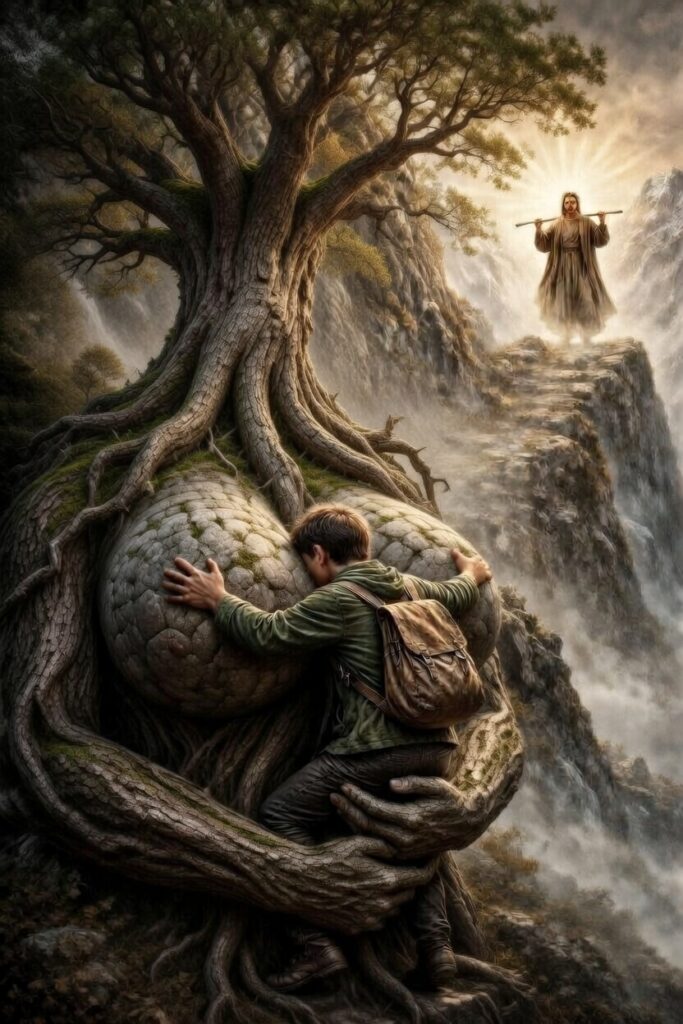
Men must leave their mothers and their homes, be swallowed by a maternal chaos, and then be initiated into the religious tradition and into sexuality. When a "young" man has undergone this rite of passage, he becomes thereafter a full member of the community; he is a man.
Why?
- Because the father serves as a protection against the dangers of the outer world and thus becomes for the son a model of the persona,
- so the mother is a protection against the dangers that threaten from the darkness of his soul.
In men's initiations, therefore, the initiate receives instruction about the things beyond (religion), whereby he is enabled to dispense with the protection of the mother.
The three-phase core—and the unavoidable boundary
Every authentic initiation follows an archetypal sequence:
- Separation — Leaving the maternal house, the childish security, the familiar world
- Liminality — Symbolic death: being swallowed by maternal chaos, physical and psychological boundary experiences until the complete dissolution of the old self
- Reincorporation — Rebirth into a higher order through introduction into the sacred tradition and the authority of the Heavenly Father
The second phase is non-negotiable. It is not enough to experience darkness, endure cold, or spend a night alone—one must truly surrender to chaos. This means: giving up oneself. The old ego, control, identification with what one has been until now, must die. Not as play, not as staged exercise, not as controlled "passage." It must be a genuine, existential act of self-surrender—a trust that from this death something new can be born.
This cannot be played. No workshop, no guided meditation, no prefabricated ritual can replace this moment. Whoever only pretends to surrender remains essentially the one in control—and thus trapped in the maternal realm. Chaos swallows only the one who truly lets go.
Why the religious dimension completes the surrender
Without the religious dimension, even the deepest boundary experience remains incomplete. The descent into chaos then leads not to the Father, but deeper into the womb of the Great Mother—whether as nature, the unconscious, cyclical becoming, or pantheistic ecstasy. The surrender becomes a return, not a resurrection.
In Christian symbolism (understood especially in a Catholic sense), the descent is completed only through Christ as the living symbol of the Self. Here chaos is not an endpoint, but a passageway. The initiate does not surrender to blind nothingness, but to the loving Father who, in the Cross and Resurrection, shows: Whoever gives himself up is not destroyed—he is redeemed and recreated anew.
The religious dimension therefore means:
- Conscious surrender to the Cross as the highest form of self-giving
- Consecration of one's own strength to truth, goodness, and beauty
- Integration of Eros into chastity as consecrated love (Agape, which unites Animus and Anima in sacred order)
- The ability to love wife and children in freedom and responsibility, without needing them as substitutes for the lost mother
The Sunday liturgy as ritualized, repeatable rebirth
The Holy Mass on Sunday is the ongoing, sacramental form of this process:
- Chaos and self-surrender are made present in the Confiteor, Kyrie, and the proclamation of the Passion
- Symbolic death occurs in the consecration—bread and wine are broken and pass away
- Rebirth is accomplished in Holy Communion: living union with Christ, the perfected Self
Yet the liturgy cannot replace the unique, radical, non-playable surrender to chaos. It presupposes it and renews it throughout life.
The longing is true—the path must be complete
Modern men's work awakens a genuine need. Yet without authentic self-surrender to chaos and without religious turning to the Heavenly Father, it remains incomplete. It awakens vitality, but does not free from the maternal sphere.
The complete path unites:
- The courageous, non-simulated descent—truly surrendering to chaos, truly giving oneself up
- The enduring sacramental rebirth—Eucharist, prayer, Confirmation, consecration of life to Christ
Whoever walks this path becomes not merely more vital or wilder. He becomes the free son of the Father—capable of true fatherhood, of holy marriage, of creative responsibility in a world that desperately needs such men.
The Church has held this dimension ready for two thousand years. Chaos waits not as enemy, but as gateway. The Father calls not as judge, but as Lover. It is possible to surrender—truly, without pretense. And therein lies the highest freedom: in the death of the old, the new is born. In giving up the ego, the Self is found. In leaving the mother's house, the son returns home—to the Father, to wholeness, to eternal love.
The path is open. The initiation waits. It is time—no longer a game —but to surrender.