The Revolt Against the Boundary – Family, Responsibility, and the Cultural Infantilism of Our Time
One of the curious developments of our time is that the word boundary has acquired a negative connotation.
Boundaries are quickly perceived as signs of harshness, control, or even aggression. Those who set boundaries appear unfriendly. Those who establish rules are easily labeled authoritarian. Those who demand responsibility are often seen as domineering.
Yet this reaction reveals less about boundaries themselves than about the condition of our culture.
For a civilization that can no longer accept boundaries gradually loses its form. And a culture without form eventually loses its orientation.
A Conflict-Avoidant Society
One striking feature of our time is an increasing avoidance of conflict. Conflicts are seen as something to be avoided. Harmony is elevated to a moral ideal. Clear words are quickly interpreted as harsh or aggressive. Yet conflict is part of life.
Where people live together, differences in interests, expectations, and values inevitably arise. A mature society is not one without conflicts, but one that has learned how to deal with them.
When conflicts can no longer be expressed openly, they do not disappear. They merely change their form. They reappear as mistrust, distance, or subtle hostility. This aversion to conflict may also have historical roots. The Europe of the twentieth century was shaped by extreme conflicts: world wars, totalitarian ideologies, and political violence. Trust in authority was deeply shaken.
Yet from this understandable skepticism something else has emerged: a general fear of any form of order.
When Boundaries Are Interpreted as Aggression
Within this cultural climate, a simple act becomes suspicious: setting a boundary.
A calm “no” suddenly appears provocative. But a boundary is not an attack. It is a form. A boundary creates a space. It defines where responsibility begins and where it ends. Without such definition, confusion arises—and from confusion arise conflicts.
The paradoxical truth is this:
It is not the boundary that creates aggression.
It is its absence.
When people are unable to express boundaries for long periods of time, frustration builds up. Eventually it seeks an outlet—and then it becomes truly aggressive. The calm boundary, by contrast, prevents escalation.
Cultural Infantilism
The rejection of boundaries has an even deeper dimension: cultural infantilism. The psychoanalyst Sigmund Freud described civilization as a system of limitations. Culture emerges precisely because human beings learn to restrain their impulses. Boundaries are therefore a sign of cultural maturity.
Yet a culture that rejects boundaries returns, in a sense, to a childlike posture: it demands freedom without accepting responsibility. The adult understands that freedom is inseparable from obligation.
The infantile mind desires freedom without duty.
In this sense, the modern rejection of boundaries is not merely a social or political development. It is also a form of cultural immaturity.
The Family as the Foundation of Society
The significance of this development becomes especially visible in the family. The family is not merely a private arrangement. It is the cultural foundation of every society.
Here human beings first learn:
- responsibility
- authority
- solidarity
- belonging
The Russian writer Fyodor Dostoevsky once wrote:
The family is the testing ground of human nature.
When the family is stable, society remains stable. When it disintegrates, culture begins to erode.
The Modern Patchwork Family
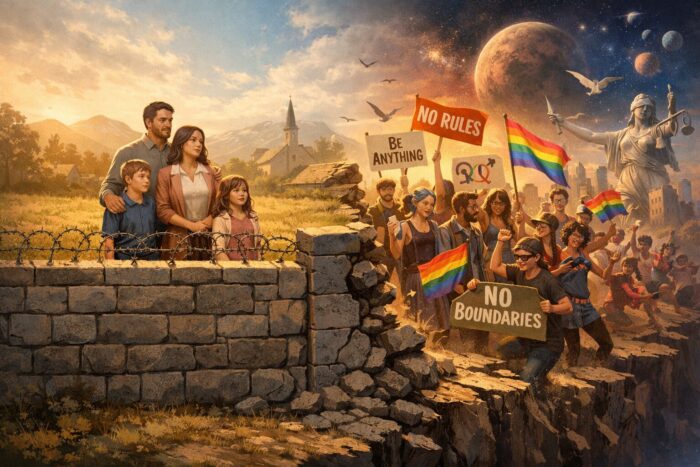
The structure of the family has changed dramatically. Many families today are patchwork structures formed through separation and new partnerships. It becomes no longer a stable community but a loose constellation of individual interests. A family without boundaries loses its form.
Wokeism and the Ideology of Limitlessness
Alongside this development, a cultural ideology has emerged that fundamentally questions boundaries: often described as wokeism. Many traditional structures—family, gender, nation, religion—are interpreted primarily as systems of power and oppression. Boundaries appear not as necessary structures of order but as obstacles to individual self-definition. The ideal becomes limitless freedom.
Identity should be freely chosen.
Roles should dissolve.
Traditions are viewed with suspicion.
Yet every identity arises through distinction.
The philosopher Roger Scruton once wrote:
A culture can survive only if it accepts boundaries.
Without boundaries there can be no loyalty, no responsibility, and no community.
The Dictatorship of Relativism
The theologian Joseph Ratzinger warned early on about what he called the dictatorship of relativism. When truth becomes entirely relative, society loses its orientation. Freedom is then no longer understood as responsibility but as permanent self-definition. Yet such freedom does not lead to maturity—it leads to instability.
Order as the Condition of Freedom
Christian thought has never understood freedom as limitlessness. Creation itself is ordered. Natural laws, relationships, and social structures follow certain forms. Freedom therefore does not mean abolishing every boundary. Freedom means acting responsibly within an order. Authority, in this sense, is not a claim to power but a service to the stability of a community. A father, a mother, a teacher, or a spiritual guide takes responsibility for a space. And responsibility always includes the ability to set boundaries.
Rediscovering the Boundary
Perhaps one of the most important cultural tasks of our time is to rediscover the meaning of boundaries. Not as instruments of oppression. But as expressions of responsibility.
Boundaries create identity.
Boundaries create trust.
Boundaries create community.
A family without boundaries disintegrates. A society without authority loses stability. A culture without form loses direction. Those who set boundaries are not seeking control. They are taking responsibility.
And perhaps it is precisely there—quietly and without spectacle—that true freedom begins.